

There is a question I have started asking the leaders I talk to.
In the last six months, how many of the decisions your AI tools generated have actually been signed off and put into production?
Not generated. Not reviewed. Not discussed. Signed. Owned. Executed.
The answers are revealing. Most leaders pause. Some name one or two. Many cannot name any.
This is not because the systems are not working. The AI tools are running. They are producing strategies, writing code, drafting analyses, modeling scenarios. The output is real and the output is good. What is missing is the moment after the output. The moment where someone in the organization looks at a generated answer and says: yes, this. We will do this. I will own this if it goes wrong.
That moment is where enterprise AI is currently stalling. And the reason it is stalling is not the one most people are working on.
In June 2025, I argued in a public talk that AI’s frontier had moved from intelligence to memory: that systems were failing not because they were not smart enough, but because they could not carry context forward. We solved meaningful parts of that problem. We built memory layers, context pipelines, modular systems. Solving memory did not solve the system; it exposed the next bottleneck. The frontier kept moving, from intelligence, to memory, to workflows, to what I am writing about today: decision systems.
The Bottleneck We Misread
For two years, the dominant assumption in enterprise AI has been that capability is the binding constraint. Better models would produce better outputs. Better outputs would unlock faster decisions. Faster decisions would translate into competitive advantage. The whole industry has organized around this assumption, from procurement strategies to research priorities to talent allocation.
The assumption was wrong. The models are already good enough for most enterprise decisions. What is not good enough is the layer of organizational machinery that sits between a generated answer and a signed decision. Recent industry research suggests that 86% of enterprise AI pilots fail to reach production at scale, and the failures are overwhelmingly organizational rather than technical. The constraint was never intelligence. It was always who is willing to put their name on the line for the answer.
Inside most organizations, decisions move through a familiar pipeline. Something gets generated. Someone selects what is worth attention. Someone validates whether the selection is correct. Someone legitimizes the validated answer, politically, narratively, in terms of accountability, into something the organization can stand behind. And only then does action follow.
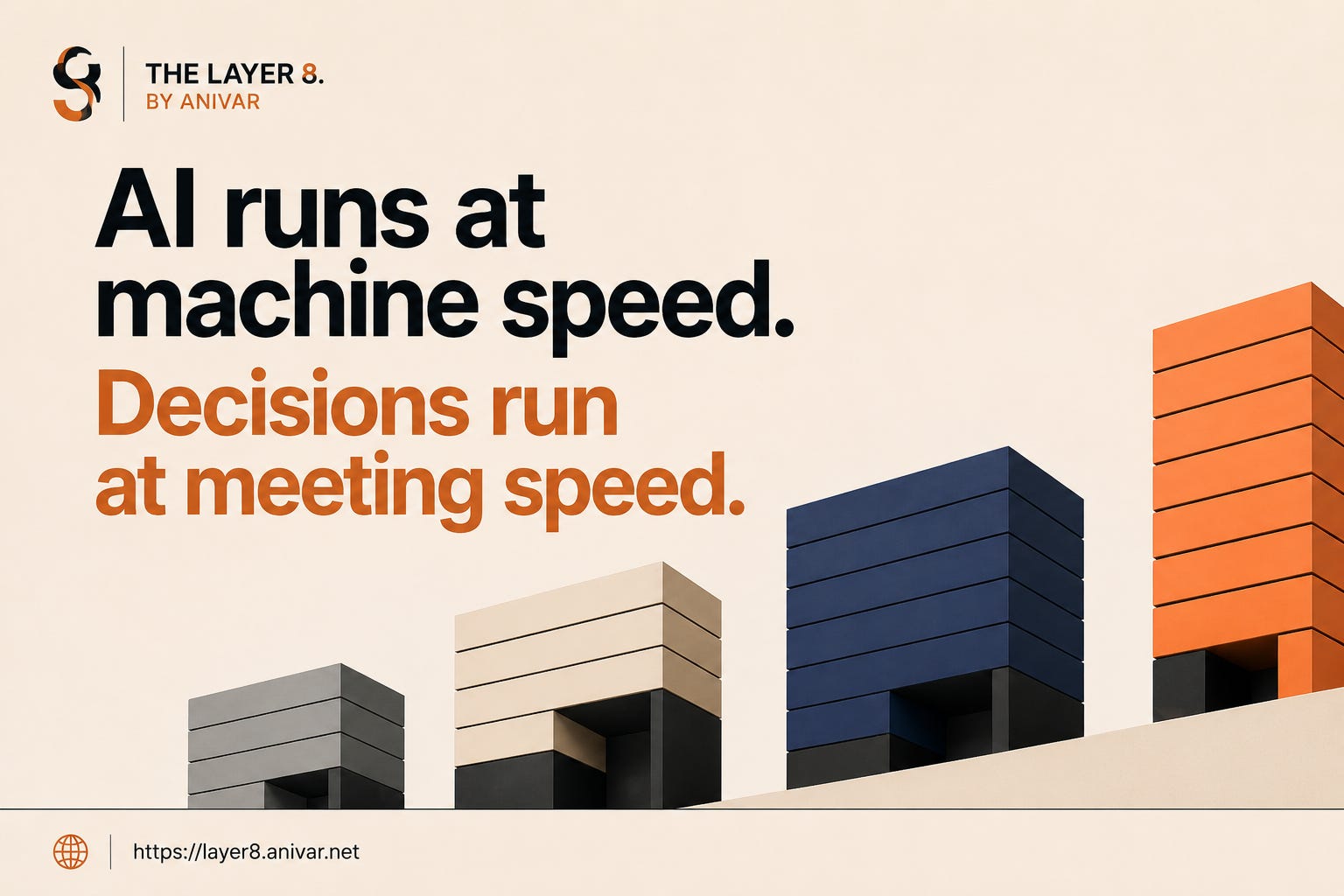
AI has accelerated the first stage by roughly three orders of magnitude. The other stages have not changed at all. The pipeline is now structurally lopsided. Generation runs at machine speed. Everything downstream still runs at meeting speed.
The visible output of this asymmetry is not faster decisions. It is unsigned strategies. Hundreds of plausible plans, each defensible on its merits, none of them owned by anyone willing to stake their name on it. Every organization has its version: the deck that never gets approved, the AI-generated proposal that lives forever in Slack threads, the we should do this insight that never becomes a commitment. It looks like progress. It is often just accumulation.
What a Signature Actually Does
To see why this gap cannot be closed by faster generation, it helps to look closely at what happens when someone signs off on a decision. The action looks atomic. It is not. Every signature is doing three jobs simultaneously, and AI has only collapsed the cost of one of them.
The first job is assertion. The claim that this is the right answer, the correct interpretation, the optimal path forward. Modern AI is extremely good at assertion. A capable model with adequate context will reliably produce a defensible answer to almost any business question.
The second job is acceptance. The willingness to own the consequences if the answer turns out to be wrong. This is not a matter of confidence. It is a matter of accountability. When a CFO signs a forecast, she is not merely asserting the numbers are correct. She is staking her professional reputation on a particular interpretation of an uncertain future. If the forecast is wrong, the cost lands on her. AI does not bear this cost. AI cannot be fired, demoted, or sued. The accountability surface remains entirely human.
The third job is activation. The political and narrative work of moving an organization to actually act on the decision. A signed strategy that nobody believes in does not produce action; it produces compliance theater. Activation requires that the signer can defend the decision in front of the board, the regulator, the team, and the customer. AI generates conclusions; humans are still the ones who have to make those conclusions believable to other humans.
Generation has collapsed in cost by three orders of magnitude. Acceptance and activation have not collapsed at all. They cannot, because they are functions of human reputation, organizational politics, and narrative coherence, none of which become cheaper when compute becomes cheaper.
This is the core mechanism. It is not that humans are slow. It is that the things humans do at the signature layer are not the kinds of things that get faster when models get better.
Why Better Models Will Not Solve This
A natural response is to assume that next-generation models will close the gap. Better reasoning will produce more trustworthy outputs. Better alignment will produce safer outputs. Better tooling will produce more auditable outputs. Eventually the asymmetry resolves itself.
This is a comfortable assumption. It is also wrong, and the reasoning matters.
The signature layer is not blocked by model quality. It is blocked by the structural cost of being the human who owns the consequences. That cost is not a function of how good the model is. It is a function of how the organization distributes accountability when something goes wrong. A model that is 99.5% accurate on a class of decisions does not change the accountability calculus for the human who has to sign the 0.5%. If anything, higher model accuracy makes signing harder, not easier, because the human signer is now staking their reputation on catching the rare cases where a highly reliable model is wrong, which is a much harder cognitive task than catching the common errors of a mediocre model.
The argument that better models will solve absorption assumes the bottleneck is trust in the output. It is not. The bottleneck is who absorbs the downside when the output is wrong. Until that question is answered architecturally, until organizations have built the inspectability, the reversibility, and the bounded blast radius that allows a human to sign with proportionate risk, better models do not help. They just produce more high-quality outputs that nobody owns.
The most sophisticated AI deployments I have seen in regulated industries are not the ones with the best models. They are the ones with the most carefully designed signature surfaces. The model is whatever model. The architecture around the model, what it can touch, what it cannot touch, what gets escalated, what gets logged, what gets reversed if it fails, is where the actual engineering effort lives. What broke was not the model. It was the system that accepts its answers.
The Hidden Layer Beneath Validation
Most leaders, asked why a particular AI-generated decision did not get signed, will say it needed more validation. The reasoning got reviewed, the data got checked, but something still was not right. So another round of analysis was commissioned, and another, and the decision drifted into the backlog.
What is actually happening in most of these cases is not a failure of validation. It is a failure of legitimization. The answer was correct. It was simply not yet defensible in the language the organization uses to defend its decisions. There was no story attached to it that would hold up under hostile questioning from the board, the regulator, the team, or the customer. AI produced the conclusion. It did not produce the narrative that lets a human stand behind the conclusion.
This is why some of the most useful AI deployments I have seen do not stop at generating the answer. They generate the answer alongside the reasoning that would survive challenge: the explicit assumptions, the alternatives that were considered and rejected, the conditions under which the answer should be revisited, the failure modes the answer is exposed to. This is not redundant work. It is the work that makes the difference between an answer and a signable answer.
The organizations that figure out how to generate this layer alongside the conclusion will move at a fundamentally different speed than the ones still treating AI as a faster spreadsheet.
The Asymmetry That Sustains the Clog
There is one more dynamic worth naming, because it explains why the situation persists even when leaders understand it intellectually.
In most organizations, the cost of not deciding is invisible. A memo can sit unsigned for two weeks and nobody notices. A strategy can languish for a quarter and nobody is held accountable. Meanwhile, the cost of signing wrong is career-ending. A bad decision signed is documented forever; a good decision unsigned is invisible.
Every rational manager facing this asymmetry discounts action. They wait. They request another round of analysis. They circulate the proposal one more time. Until inaction has a measurable cost, until not deciding is also a decision someone has to sign for, organizations will continue to default to delay regardless of how good the AI outputs are.
This is the asymmetry that sustains the clog. It is also the most fixable part of the system, if leadership is willing to make inaction visible.
What Changes in the Organizations Doing This Well
The organizations that are successfully shipping AI at scale are not deploying smarter agents. They are redesigning the signature layer. Three patterns show up consistently.
The first is decision tiering. Not every output needs a signature. A reversible action with a small blast radius can run autonomously, with humans auditing the anomaly log rather than approving every execution. An irreversible action with a large blast radius requires explicit human authorization with the full context attached. Most organizations today treat all AI outputs identically. Every output gets the same review process regardless of consequence. This is structurally wasteful and behaviorally counterproductive. It trains humans to rubber-stamp, because rubber-stamping is the only way to keep up.
The second is signing the boundary, not the output. The traditional model has the human reviewing each output and approving it. The new model has the human signing the constraints: what the agent is allowed to touch, what triggers an escalation, what the failure modes are, and then auditing the agent’s behavior against those constraints. The leader signs once, at the boundary level. Everything operating inside that boundary is pre-authorized. Accountability moves upstream from output review to constraint design, where the leverage is higher and the cost is paid once instead of ten thousand times.
The third is making inaction visible. Some organizations are starting to treat not deciding as a decision that itself requires a signature. Deadlines are enforced. Ownership is assigned. Delay is logged. This is the simplest of the three shifts and the one most organizations resist longest, because it changes the political economy of meetings.
These three shifts are not novel ideas. They are the operational substrate of the most mature AI deployments in regulated industries. What is new is the recognition that they are not optimizations layered on top of model deployment. They are the primary engineering problem. The model is the easy part.
The Reframe
For two years, the question driving enterprise AI strategy has been which model do we use. The question that will drive it for the next two is how do we redesign accountability so the model’s outputs can actually be owned.
The organizations that figure this out first will not be the ones with the smartest models. They will be the ones with the shortest distance between generated and signed. That distance is not a function of compute. It is a function of how the organization has architected the layer where decisions stop being computational and start being institutional.
I have started calling this layer the signature surface. It is the part of the enterprise that determines whether AI capability translates into organizational capacity. Most organizations have not yet noticed they have one. The ones that have are quietly running ahead.
What is the last AI-generated decision in your organization that actually got signed?